

2023 Sees Highest Number of Insolvencies Since 1993
According to the latest figures from the Insolvency Service, there was a total of 25,158 company insolvencies in 2023, a worrying 30-year high.
Insolvency numbers have been rising year-on-year since 2019 – and 2023 has now eclipsed the record-high levels registered in 2009, amassed in the wake of the 2008 Global Financial Crisis.
2023’s record appears to be a consequence of the pandemic and the ongoing cost of living crisis.
While the Insolvency Service has highlighted that the rate of insolvencies per 10,000 active companies remains considerably lower than 2009 recession levels, industry leaders do expect 2024 to be another record-breaking year.
Contents
The Distribution of Insolvencies
2023 saw an increase in the usage of all insolvency procedures. However, some were used more than others.
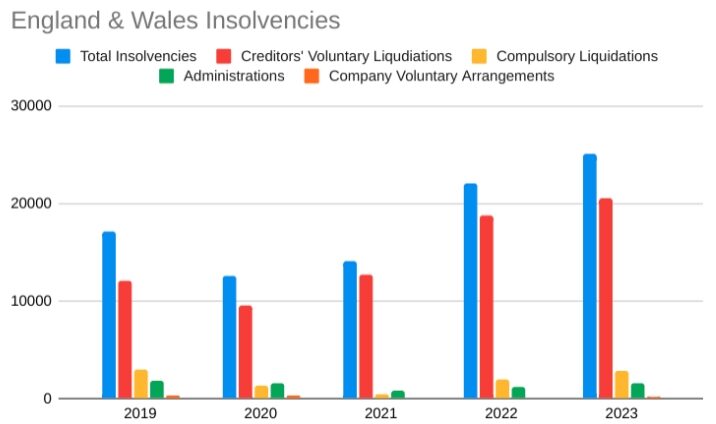
In 2023, there were 20,577 Creditors’ Voluntary Liquidations across England and Wales, a 9% increase from 2022. It is the highest number of CVLs since records began in 1960.
Worryingly, the number of compulsory liquidations also saw a rise – and a very sharp one at that. There were 2,827 compulsory liquidations in 2023, a staggering 44% increase from 2022.
While their numbers remain low, business rescue procedures also saw a rise this year.
1536 companies entered into administration in 2023. This marks a significant 27% increase from 2022. A further 185 companies entered into a Company Voluntary Arrangement, a 67% surge from last year.
Liquidations have made up the large majority of insolvency cases, while the proportion of companies opting for business rescue procedures has decreased.
CVLs represented 82% of insolvency cases this year. Compulsory liquidations represented a further 11%. That means only 7% of companies utilised a business rescue procedure.
Business rescue methods are increasingly falling out of use. 4167 companies entered into administration in 2009. However, now just 1633 businesses have entrusted their company to the hands of an administrator.
Some suggest this decline is due to low confidence amongst company directors. Others suggest it is the result of an increasing number of directors seeking help when it is too late and the business is already beyond the point of rescue.
Which Industries Are Experiencing the Most Insolvencies?
Nearly all large industries faced increased levels of insolvency in 2023 thanks to the economic turmoil of the cost of living crisis. However, certain industries have felt the impact of the UK’s strained economy more than others.
- Construction: 4371, 18% of cases
- Wholesale & Retail Trade: 3929, 16% of cases
- Hospitality: 3757, 15% of cases
While the construction industry continues to represent the highest proportion of insolvency cases, the hospitality industry has seen the sharpest rise in the last year, with a 37% increase in insolvencies.
What Does This Mean for 2024?
Industry experts predict that 2024 will not buck the trend and instead see a continuation of the year-on-year increase we have witnessed in insolvencies.
This is thanks to the UK’s difficult economic position. Higher interest rates, rising inflation, and lower consumer spending have created a perfect storm for many businesses.
Trade credit insurer Atradius has forecast that insolvencies will rise again in 2024 but at a decreased rate of escalation, perhaps indicating the beginning of economic stabilisation.
According to their predictions, 2024 will result in 28,000 company insolvencies.
This means that although there may now be a light at the end of the economic tunnel, many more business owners will have to face the unfortunate prospect of insolvency.
Speak to an Expert
If you’re a business owner struggling with unaffordable debt, it’s important you speak to an insolvency practitioner as soon as possible.
Delaying can allow your debts to spiral beyond control, reducing your options and losing your chance to make a successful return to profitability.
Our team can assess your situation and guide you to the solution that’s right for you. Get in touch today to book a free consultation.

